
SPAG members enjoyed a guided tour on 17 November 2023 around a 600-year-old site in Manchester’s medieval quarter, and spent time in the building that would one day become “Chetham’s Library,” said to be the “oldest public library in the English-speaking world.”
The original medieval building was built (to house the priests for the church that would become the current Manchester Cathedral) in 1421 by Thomas de la Warre, then Lord of Manchester and Rector of the parish church, and whose descendant two centuries later would become a governor of the Colony of Virginia in the “New World”, and whose name would later be given to an American state – “Delaware.”
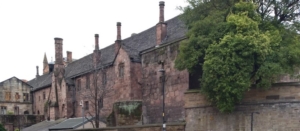
The view from Hunts Bank of the medieval building that became Chetham’s Library
The tour included the medieval Baronial Hall and cloisters, off which were the doors to priests’ cells (some with medieval cat-flaps – the cats were apparently needed for catching rats!)
Two centuries after the building was established, and following the religious and societal tumult of both the Reformation and the English Civil War, Sir Humphrey Cheetham (1580–1653) – a successful cloth merchant, and sometime High Sheriff of Lancashire – established a school (“Chetham’s Hospital”) towards the end of his life for the education of “forty poor boys”. Upon his death, his Will further stipulated that a library should be established, and that it should be free to use.

The gated bays and shelves at Chetham’s Library
We were able to view the wonderful gated bays and shelves of the library commissioned by Cheetham’s Trustees, and view the spectacular architecture of the library itself:
Cheetham’s Will also made provision for five “parish libraries” – small libraries whose books were chained to the library cabinet – to broaden the opportunity for the education of the “common people.” This one now at Chetham’s Library used to be in Gorton, Manchester:
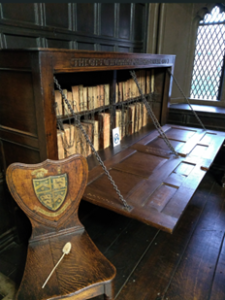
The Gorton “parish library”
The only other surviving one of the original five parish libraries is from Turton Chapel, and is now at Turton Tower, Lancashire.
As well as amassing an impressive collection of books, the trustees and librarians acquired some rather more unusual items, either bought or donated to its collection.
One pair of unusual artefacts that we were allowed to be seen and handle were a pair of “clog almanacs.” These curious items (looking like old-fashioned policemen’s wooden truncheons, but rectangular with notches and symbols evident in the wood) were carved in a way that showed weekdays, Sundays, and saints’ days, and so would allow illiterate people to use as a kind of calendar.
The clog almanacs, as well as other curiosities and we also saw a “Luddite ticket” of 1812 (from the “Manchester Scrapbook”).
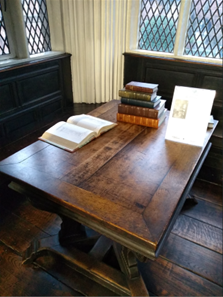
The alcove and table where Marx and Engels met and studied
Finally, we were able to sit at the actual table, and peruse facsimiles of some of the books, used by Marx and Engels as they looked out of the window at the plight of the urban poor: a small table, from which big ideas and changes came…
SPAG members present were very grateful for the excellent tour given by Siân-Louise Mason, Visitor Services Coordinator at Chetham’s library. Siân-Louise also reminded us that the library’s collection is available for readers to visit and access – for free – by arrangement with the library. If this is of interest to you, please follow this link.
Chris Ainsworth
The author confirms the photographs in this article are his own.

