
Visit to Salterforth, near Barnoldswick, 29 August 2024
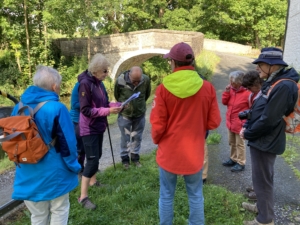 We met on the canal Wharf at Salterforth and learnt that the village took its name from the FORD that went across the stream that runs through the village and was used by the pack horse trains that carried SALT from The Cheshire mines into Yorkshire.
The village was once more important than it looks to today thanks to the coming of the Leeds and Liverpool Canal in 1816. It played a central part in the transportation of stone and lime from the surrounding quarries that have all now closed. It was interesting to note that the quarries on the Western side of the canal produced Gritstone and on the Eastern side, Limestone. Gritstone was transported to the canal at Salterforth by two tramways, and most of the stone setts which line the streets of places like Burnley and Accrington were taken from here by horsedrawn canal boats.
During the 1st World War it was decided that two places in Britain would be used for the storage of Cordite explosives. One was in Gloucestershire and other was on Salterforth Moss, between the canal and the Kelbrook/Foulridge road. A network of sidings, connected by rail tracks from the main Skipton to Colne line were built, and Nisson Huts were erected. The site was selected because of its accessibility by rail and the absence of settlement on this almost flat valley floor ; it also adjoined the Leeds & Liverpool Canal where the boxes of cordite could be delivered or dispatched by barge. A number of storage huts were constructed on short concrete pillars at various locations within the site, around which was a perimeter fence. The rails are thought to have been lifted by 1929 and the last remains of the storage huts disappeared in the 1950s.
Due to its proximity to the Cordite Store, Foulridge, the village to the South of it, had a Methodist Chapel that gained the curious distinction of being one of the few buildings insured against Zeppelin raids.
There were so many religious denominations here, in a small village. They had Quakers/ Inghamites/ Methodists/ Baptists/ and a long lost medieval chapel of ease.
We learnt about the rare Inghamite Chapel that was one of only two that survived into the 21st century. and were very kindly shown around inside. It closed its doors in 2010 and is now privately owned by the Blade family. We were also able to see the restored Reading Room and the Quaker Meeting House nearby.
Castle House, was where Cromwell used to stay and Cobble Row, adjacent to it, was the barracks for his men when they were stationed there in 1642-43, when battles took place in nearby Thornton.
The cotton mill that provided employment from 1888 finally closed in 1974, before Silentnight took it over for a few years, but it was good to see that at least half of it remains and is being turned into luxury flats.
At lunch time we made our way to the old Grammar School at Earby, an attractive Elizabethan style house built in1600 of local sandstone. It was left by the philanthropist clergyman Robert Windle for educational purposes. Initially it was a mainly free grammar school that closed in 1911. Since then, it was used for various purposes until the 1970’s when the Earby Mines Research Group took over the building and turned it into a Lead Mining Museum, and during that time helped with the alterations and maintenance of the building. This closed in 2015, when most of the artifacts were transferred to the Dales Countryside Museum in Hawes. Since then the Grammar School has been in the hands of the Trustees, and monies that are raised from the group cover the cost of repairs to the building and grants to local schools and groups working with children.
We were welcomed by the volunteers there, and enjoyed a lunch of soup, roll and delicious homemade cake, before hearing the history of the Robert Windle Foundation from Margaret Brown (trustee), and visiting their charity shop.

