
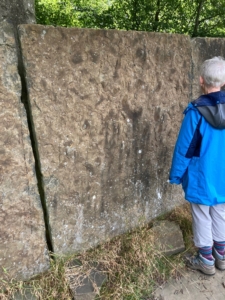
 Having postponed a talk due to Covid, 21 members of SPAG undertook a stroll around Stacksteads on a chilly January afternoon. Walking by the side of the Rose & Bowl, we crossed the route of the old railway and the River Irwell to arrive at what has to be the most impressive flag wall in Rossendale. Presumably erected as a security barrier to protect the Spring Hill reservoirs, one can only wonder at the effort required to transport and erect these huge stones.
Returning to cross Newchurch Road we viewed the remains of the local industries, quarries, brickworks, textile mills and their associated tramways which littered the area.
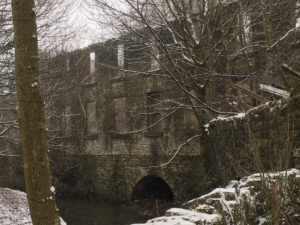 Heading uphill we crossed the turnpike road above tollbar, past St Joseph’s Primary School which was built on the site of the old coal staithe. This brought back memories to at least one of our group of the coal wagons unloading ready for use by the mills and householders.
Stacksteads used to have a high proportion of 19th century back to back houses but it also has the Grade II* listed Waggoners Tunstead, which has the oldest datestone in Bacup, 1632. Built as a farmhouse it was at one time the Waggoners public house but is now a private residence and is currently up for sale.
Tunstead was also the site of a medieval vaccary or cattle farm and as we paused for breath by Mitchell Nook Farm we wondered exactly where the low lying winter pasture and higher summer pastures would have been. Our furthest point was the site of our 2019 archaeological dig which we have sadly not yet been able to return to. Archaeologist Catherine Rousseau will be discussing this on a walk on Saturday 22nd January. More details at https://www.facebook.com/discoverarchaeologyaecs
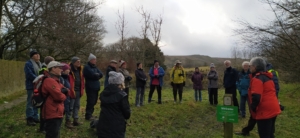 At the site of the 1733 poorhouse, now Mitchell Nook, we heard that in 1838 it had 200 inmates crowded into a relatively small area. In 1848 it was reported that a married couple in the 40s, shared a bed with their two children. It was replaced by Pikelaw in 1870 (later to become Rossendale General Hospital) which is now a housing estate on the Rawtenstall and Haslingden border.
Retracing our steps down Maden Lane we took a quick detour to Honey Hole Farm to view the buttresses below the old tramway. Coal wagons from Hile colliery crossed a bridge over the clough at this point and the story goes that the farmer had a scarecrow in his garden. As the miners returned on the wagons, they’d throw coal at it. All the farmer had to do was to pick it up in order to have a roaring fire in the evening!
The walk was perhaps best summed up by one of the group ‘I’ve walked this area many, many times but I had no idea here was so much to see.’

