
 Despite a wet and windy forecast seventeen members met up at Oswaldtwistle Mills to walk to the nearby Aspen colliery coking ovens (known locally as the Fairy Caves).
Our first port of call however was the site of Foxhill Bank Calico Printworks. Now a Nature Reserve the area was once a bustling industrial site with a bleach works as well as the myriad of buildings required for the dyeing and printing of calico cloth. We looked at the two large weirs on Tinker Brook which controlled the water into the Works a short distance downstream. In 1797 the Printworks was owned by Peel and Yates. Robert Peel of Oswaldtwistle (more about him and his family in our talk next month) married Elizabeth Yates and popularised the ‘parsley pattern’. We learnt that only the Coach House now remains of the large Foxhill Bank Estate.
Dodging the showers we continued under the railway viaduct built for the East Lancashire Railway in 1848. The owner of Foxhill Bank Hall at the time was James Simpson who embellished the stark and functional railway viaduct with balustrades and niches.
Passing Holly Mount House, built for William Blythe, we crossed Blackburn Road to view what remains of the

1836 canal warehouse, sadly badly damaged in a fire in 2022. Martin gave a short history of Blythe’s Chemical Works situated by the Leeds and Liverpool canal. Founded in 1845 it is one of the longest surviving chemical businesses in the UK. Starting as a manufacturer of chemicals for the local textile industry, William Blythe’s today is at the forefront of modern chemical engineering research and development, involved in the production of graphene and other new advanced materials.
A short walk along the canal brought us to the coke ovens site. Barbara explained that the Aspen colliery coking ovens site is the most complete 19th century example in the North West and one of only 11 to survive in the country. The survival of the Coke ovens in their colliery and canal-side setting illustrates how coal was mined, coke produced and how the product was then distributed along the canal network.
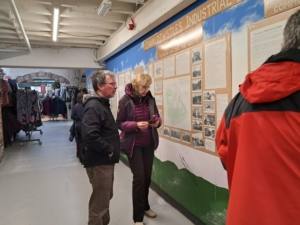
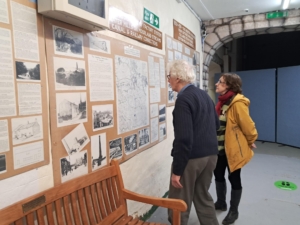 After a satisfying lunch at Oswaldtwistle Mills the group spent some time in the small museum there investigating the history of the Oswaldtwistle area from the Neolithic to the Present Day.

