
Heptonstall visit 31 October 2025 – by Frances Bland
After two postponements, it was good to meet up on a fine day in the wonderfully well-preserved and unspoilt village of Heptonstall.
Our group visited the renowned Octagonal Wesleyan Chapel, which was opened specifically for our tour. We learned about its origins, including John Wesley’s role in laying the foundation stone, and had the opportunity to examine the interior. It was sad to see the empty Sunday School but did wonder, with the rather awkwardly accessible position of it, what it could be used for. On the way to the chapel, we learnt the history of various buildings, admired their architecture, and saw where the nearby navvy settlement of Dawson City had been. It housed over 600 people associated with building the reservoirs at nearby Widdup and Walshaw Dean. This was from 1901 to 1908 and badly affected the residents of Heptonstall, as until they built their own school and Inns etc, the village was overwhelmed.
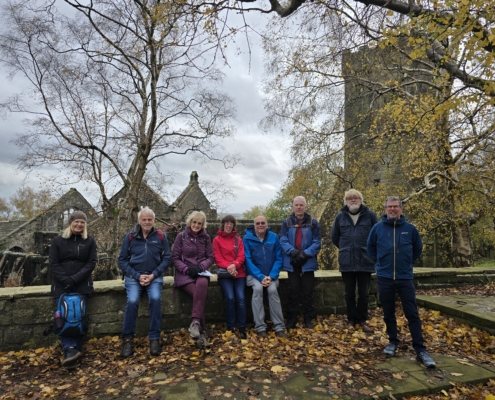 We heard about the Post Office being taken over in recent years by the Heptonstall Community and how the Cooperative store, opening in 1866 (until 1963) altered many of the buildings surrounding it and made a big difference to the lives of the villagers during that time. They had a large bakehouse and a café and we were able to identify the buildings that were once the shop, their stables, garages and abattoir. We looked down the well that was used by the residents in the centre of the village before they had piped water and heard that in 1832 around 76 villagers died of cholera, after the route to it was found to have flowed beneath the graveyard.
We saw the sites of six out of the seven Inns that were once here (there being only two left today), and the old Cloth Hall and Grammar School, now a museum, that was originally built as a warehouse for wool. It was interesting to examine the architecture from both the front and the rear.
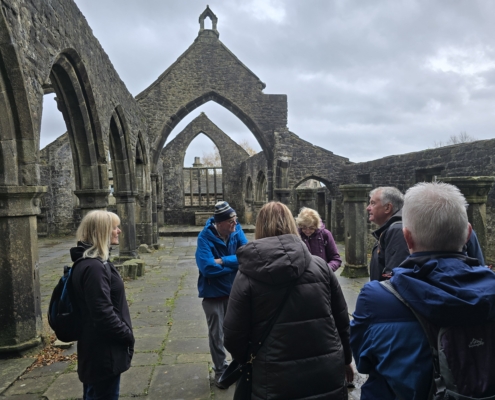 In the churchyard, we learnt about the Cragg Vale coiners who amazingly very nearly brought down the Bank of England with their activities in the 1760’s, and saw the grave of their leader, David Hartley who was hanged at York in 1770. The Churchyard is rare in that it houses two churches, one a striking ruin (now a scheduled monument) that we were able to explore before visiting the presently used church of St Thomas the Apostle.
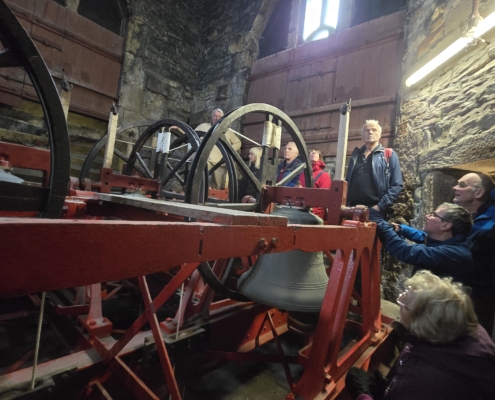 There we were given a warm welcome by Graham Kidd who led us up the very narrow spiral stairway in the tower to see the interesting workings of the church clock that had been built by Titus Bancroft for the original church in 1809 and moved here in 1854. The engineers amongst us were intrigued by its workings and it was good to see that it was still in good working order. We then continued up, our stairway going even narrower, almost to the top of the tower, to see the eight huge bells that had been sent away for conservation and recently put back in place. When we were in this confined space, high up in the tower, we were full of admiration when we heard about how this mammoth and awkward job was achieved.
We did fit in a visit to Sylvia Plath’s grave, wife of the poet Laureate Ted Hughes, and heard about the tragic circumstances surrounded her death and others associated with her. The grave, often visited in the extended graveyard, was as usual adorned with fresh flowers.
Latterly we explored the upper part of the town with its communal well and passed by interesting weavers’ cottages, the old Mechanics Institute, Weavers Square, and admired the architecture of the Star Chambers and various other buildings.
This truly is a gem of a village.
The rain held off until mid afternoon so we were very lucky with the weather, for when it came as we were driving home, it was very heavy indeed.

