
Musbury Heights Weighbridge
Located in a field at the the apex of Grane Road and Holcombe Road, this was the end of the tramway which started on Musbury Heights quarry, came down the incline, skirted Holden Wood Reservoir, passed under Holcombe Road and immediately after the weighbridge appears to have split into two. Between the two spurs is a hollowed out section which we believe to have been the end of a standard gauge siding leading to the main Clifton Junction to Accrington railway line. This would have allowed the tramway trolleys to be tipped directly in the railway wagons or alternatively craned aboard. These can be seen quite clearly at the top left of the 1893 OS 25inch map. It would be interesting to know more as the quarry is believed to have produced flagstones, kerb stones and setts.
Using Mike Rothwell’s ‘A Guide to the Industrial Archaeology of Haslingden and Helmshore’ published by Bridgestone Press we learn that the tramway was constructed by Hargreaves & Bolton who took over the quarry in about 1872. It closed in 1931 but locals still refer to the weighbridge in the field. The tumbledown shed appears to have been constructed for agricultural use at a later date, on the site of the building shown on the B&W photograph from the 1950s.*
We had planned to survey the site in Autumn 2022 but as the site has been sold for house building, our visits were brought forward to June, when the vegetation was at its highest. On the day of our group visit, surveyors were already at work!
From L to R
Looking East from inside the shed Looking West towards the shed Looking East from North side of the shed
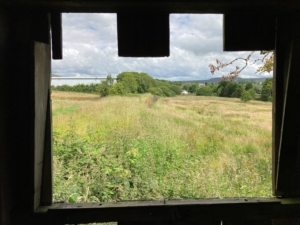
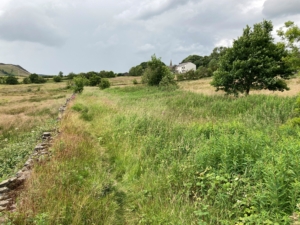
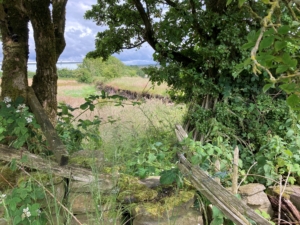
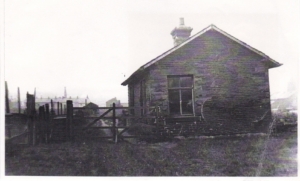
*Grane Weighbridge 1950s. WP Riley collection
Since this was written, three of our members revisited the site to investigate a single brick width wall made with bricks,white glazed to both sides and crossing the existing path about 100 metres from Gas Street. With a definite stream channel to the North of the path which continues under the path before emptying into lower, marshy ground, we therefore believe this to have been a toilet cubicle. The remains of an Accrington brick building could also be seen by the retaining wall in the field below.
A discussion with a local resident answered two of our questions. 1. Was the field below the track owned by somebody else? Yes. In which case the red brick building is unlikely to have anything to do with the tramway. 2. We’ve been puzzled by the single spur tramline to the South of the main tracks which stops a few yards before Gas Street. We are now told that some stone was moved by road transport, so this was almost certainly the loading bay from which the stone could be tipped directly or indirectly into a waiting cart or later, a motor vehicle.

