
 “It is written on a wall in Rome that Ribchester
was as rich as any town in Christendom.”
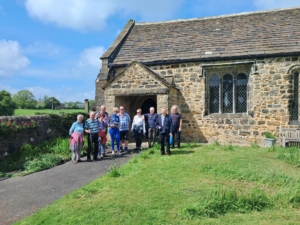 We spent an interesting day in the Lancashire village of Ribchester situated on the Banks of the River Ribble, named as Bremetennacum Veteranorum, by the Romans in AD78. This was during the reign of Emperor Vespasian, when Britain was under the leadership of Julius Agricola. The fort here housed soldiers not only from Rome but from Spain, Iran and Hungary and was occupied for over three centuries. It remained in use until well into the 4th century when the legions were recalled to Rome to defend the city which was surrounded by hostile tribes. The Ribchester buildings gradually collapsed from neglect over a long period of time.
The day began by walking on a lovely Spring morning along a footpath where we were able to clearly see the defensive ditch which was just outside the Fort Area. At this point we studied photographs of the perimeter of the fort which had been superimposed on an aerial photograph. This covered an area around the present St Wilfred’s Church. It was interesting to note that one corner of the Fort was where the present River Ribble is now, showing how much the course of it has changed over the last 2000 years.
We had an interesting visit to the little Roman Museum, which houses a replica of the famous helmet, found here in 1796 (the original is in the British Museum). We learnt a lot about the Roman occupation and enjoyed seeing interesting stone sculptures, pillars, cooking pots, quern stones, leatherwork and jewellery etc, that were all discovered in the village. Our member, John Trippier, was able to decipher some of the inscriptions for us.
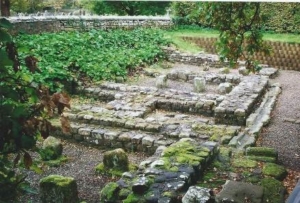 We then viewed the archaeological excavations of the Granary nearby. After this we studied the exterior and then the interior of the 13th century Church of St Wilfred’s, built on the site of an earlier church possibly dating from the 6th century. Inside was a medieval wall painting of St Christopher, an ancient font which still had its original staple so that the lid could be locked to safeguard the holy water being used for witchcraft, a leper’s squint (Hagioscope), an Aumbry, four Piscinas and a triple seated Sedilia.
Now it was time to head off to Potters Barn Café for a nice lunch, and on the way it was pointed out where the famous Ribchester Helmet and the nearby watch tower site was discovered. We studied some interesting buildings, including the White Bull Hotel with its Roman Pillars, and several rows of weavers cottages.
A modern feature of interest was the Millenium Sculpture gardens with work by Fiona Bowley depicting many of the buildings and roman artefacts from the village.
As we walked through the village we learnt the history of several buildings and saw the still existing building of Bee Cotton mill, now in separate units, and the site of the previous Ribblesdale Cotton Mill. We learnt that a Mill Lodge was built where there is now a row of houses, to serve a Bobbin Mill (now demolished) which was previously a Corn Mill.
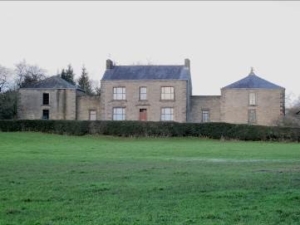 Walking ½ a mile out of the village in the sunshine, we came to the hamlet of Stydd, firstly to view from across the fields, the Catholic Barn Church of St Peter and St Paul. This was built in 1789 and the site carefully chosen for it was still illegal for Catholics to have public places of worship. The Bailiff’s house was built with a barn on either side, with their gables facing the road, which originally would have looked identical, but since then the church side has been extended and a cross and tiny bell tower added to the roof. However when we viewed the buildings from the road, apart from the cross and bell tower, one couldn’t have known that one of the ‘barns’ was a church. It is the last of what are traditionally known as ‘Barn Churches’ and therefore very rare, others having been altered or pulled down.
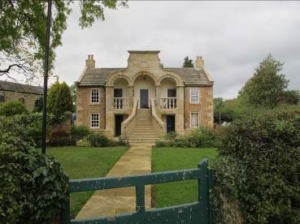 Nearby the architecture of the Alms-houses, built in 1728 for five poor widows and the schoolmistress by a local wealthy benefactor, was a joy to behold.
After this we walked up the farm track to the fascinating little chapel of St Saviours standing in the field surrounded by sheep. Its origins stem from 1136 when it enjoyed the patronage of the Knights Hospitallers. In the following centuries it fell into dilapidation and was renovated and restored in the first quarter of the twentieth century. It retains many original period features and is now a Grade I Listed building. Within its walls is a tombstone in the floor marked only with a cross, reputed to be the last known resting place of the martyr St Margaret de Clitherow of York, who was brutality executed during the 16th century Catholic persecutions.  There were several interesting features including a large stone coffin-tomb of great antiquity and this plain tranquil church, which had provided a common ground for reconciliation between opposing faiths in turbulent Tudor times, left us all feeling the atmosphere of its unique past.
It was pointed out by John, that besides the chapel, there would have been a hospital here providing shelter for pilgrims and lepers, and he told us about excavations made at the beginning of the 20thcentury by students from nearby Stonyhurst College.
From this atmospheric tranquil place, we made our way back into the village, to the interesting, excavated remains of what was once a large Roman Bath House discovered in 1837. To reduce the danger of fire the bath house was built outside the fort walls. Incredibly, until as late as the 1960s, the remains although still impressive, were not protected until 1963 when more excavations took place. Until then the site had been robbed many times of its stones, pillars, and tiles for use in other buildings. Studying the remains and notice board, we were able to see the flues where furnaces heated the rooms and small stone pillars that had supported the floors of the bath house and created a space below, allowing hot air and steam to circulate. This left us in wonder at just how advanced the Romans were with their heating systems etc.
Leaving the site we made our way back to the garden of Potters Barn for a final get together to chat and enjoy some ice creams.

