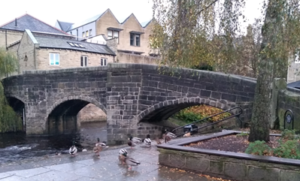
Hebden Old Bridge
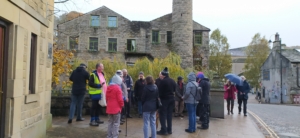
Calderdale guide David Cant led our SPAG group on an interesting and enjoyable – if wet – tour of a selection of vernacular buildings and industrial archaeology of Hebden Bridge.
Starting in St George’s Square, we saw a sculpture (which doubles as a sundial gnomon) of a “fustian knife,” fustian being a textile made locally which provided hard-wearing clothing such as corduroy, and which needed skilful cutting to provide the finished product.
We saw the steeply descending road – “The Buttress” – which formed part of the packhorse route from Burnley and Colne as it descended from Heptonstall into the Calder valley to cross the “Hebden Bridge” before then ascending from the valley bottom to the east, on the way to Halifax.
Tim Midgley’s webpage shows the nearby packhorse routes:
A stroll over Hebden Old Bridge made history tangible. The medieval timber packhorse bridge was replaced with the stone bridge around 1510, later “undergoing repairs in 1602” and subsequently.
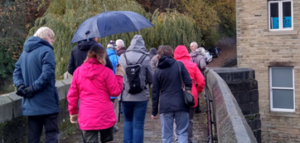
Guide David Cant escorting the SPAG group over Hebden Old Bridge
Walking along the Rochdale Canal gave a great view back to the old five-storey houses that cling to the valley sides, as well as seeing a canal side tollkeeper’s house – with windows strategically placed to make sure no bargee got away without paying the toll.
David pointed out an interesting feature on the aqueduct that carries the Rochdale Canal over the River Calder – an “archaic head,” which some think was intended to be a spiritually protective feature:
The tour whetted the appetite for further visits to other Calderdale towns and villages in future to explore their heritage and archaeology.
If you are visiting Hebden Bridge in the future, a visit to the old Hebden Bridge Mill is recommended:
Not only do the wall plaque displays explain the local history time-line, but “old meets new” where an Archimedes Screw driven by waterpower provides the Mill with an updated function – providing clean, “green” energy for the complex!