
This was a follow up after members had been viewing a recording of a 1980’s Titus Thornber’s talk, a couple of weeks ago about the Lead Mine on Thieveley Hillside above Holme Chapel, that opened in 1629 almost four hundred years ago. This covered six turbulent years during which the lead mine was discovered, two smelt mills built and its eventful closure in 1635.
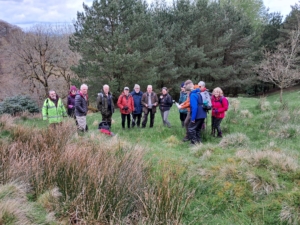 We met on The Ram Inn Car Park and walked up the station track towards the Railway where David told us about the history of the Railway and old station. He pointed out The Holme, where the Whitaker family lived, and told us about their private route (now an official footpath) across the fields and over a specially built footbridge, to the station, so that they didn’t have to mix with any of the ordinary people.
After this the path became very steep, stepped and muddy as we climbed through the woodland.
Upon arriving at the site of the lead mine founder Robert Hartley’s farm,(demolished in the 1970’s), we were able to look around the five shafts on the hill to its rear, and Richard was able to take us to the dressing floors and explain where the water was brought from and tell us all about the dressing process and show us some galena (the lead ore mineral). In the beginning the mine flooded so it had to close, to allow for a drain (adit) to be tunnelled through the hillside lower down, to drain the water away. We saw where the adit, way down the hill, had been. It had now collapsed, though water was still running from it, and it was in a much worse state than it was forty years ago, when Richard had accompanied Titus on his quest to fully understand the mining area.
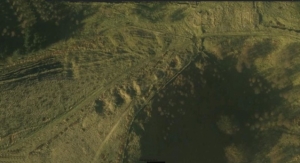
Aerial photo taken from above the mine looking downhill, showing watercourses, five shafts and the footprintof the farm (towards top right)
So many trees had sprung up during this time and we were able to appreciate that if so much had changed in the area over only 40 years, just how much the landscape can change in 400 years!
The site of a further two shafts were seen directly behind the farm. Due to Titus’s diligent research of the documents from the court proceedings of the time, we now know that the Smelt Mill was built next to, but separate, from the farm. Many years after its closure, it was thought to have been incorporated into the farm when it was partially rebuilt. We learnt that the mill was costing too much to run and closed down in 1632, after only 3 years and another one was built besides the River Calder. We were able to imagine where the miners, brought all the way from Derbyshire, built their turf houses to live and work in this harsh environment.
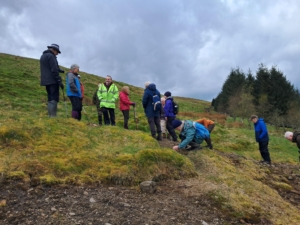 We had a picnic lunch near the farm, that at the beginning of the 20th century served teas and refreshments. As we headed off down the farm track we were shown the area where the Victorian families, after climbing up from the railway station, were able to have rides on donkeys, roundabouts and swing boats. It was all so surreal.
A pleasant walk downhill took us under the railway to eventually explore the fish pond area that TD Whitiker had created, and where Titus was instrumental in getting it all cleaned up from dereliction, and at the same time Todmorden Anglers took it over and did a great job in opening it all up. We saw the site of the dam and the leat that carried water to the wheel pit for the second lead Smelt Mill, although again, only forty years after Titus’s excavation, it was barely recognizable. We learnt that roughly a hundred years after the Lead Smelt Mill closed down, the same site was taken over and its wheel reused when a new Blast Furnace was built to smelt ironstone, which was mined from the nearby Riddle Scout.
Finally we saw the restored pack horse ginnel, used by ponies to bring the ore down from the mine.
Walking back along the main road, passing the beautifully restored Holme, we were able to see the entrance to the tunnel under the road for Whitaker’s private footpath to the railway.
Needless to say some of us ended up in the Ram Inn for much needed refreshment and a chat.

