
Industrial Summerseat Walk
SPAG Researcher Elspeth Dennett volunteered to take members on a guided tour of Summerseat to discover the village’s industrial past.
 Our starting point was the local Garden Centre just a short walk away from our first point of call, Robin Road Mill, a water powered spinning mill built around 1780 by Peel and Yates who had calico printing mills in Bury and Ramsbottom. Although nothing is left of the mill we were able to visualise it with the aid of an old photograph provided by Elspeth. The workers’ cottages remain and are still inhabited today. On April 26th, 1826 the then owner had 38 power looms destroyed shortly after the Chatterton massacre occurred (see the report on this in Past Events).
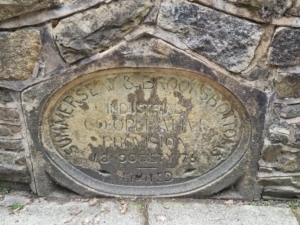
Continuing our walk we passed over Holcombe Brook which provided the water supply to the mill. Further on one eagle-eyed person spotted this old stone sign set in the wall which reads ‘Summerseat and Brooksbottoms Industrial Co-operative Provision Society Limited 1876’.
The Brick Houses. Ten rows of back-to-back brick houses were built by Joshua Hoyle (more on him later) in 1885 to accommodate his employees. In 1985 six rows were demolished and the remainder became ‘through houses’. The photo shows how close the original rows were to each other.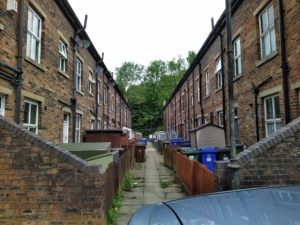
Further along past the houses we began to ascend a steep cobbled lane, known locally as The Nutts as it leads to what was the village of Nuttall. We followed the Bury to Bacup railway line built in 1846, now a Heritage Railway which terminates at Rawtenstall. Nuttall was once a busy thriving village boasting three mills in the first half of the 19th century. The Ocean Chemical Works which closed in 1931 produced an assortment of nasty chemicals and noxious fumes. At one time it was the only cyanide-making factory in Britain. Most of the village was demolished in the 1940s leaving only one house, 17 Lower Nuttall Road.
 Retracing our steps we walked under the railway viaduct (which does a good job of cutting Summerseat in two!) and came upon the Italianate designed Brooksbottoms Mill built by Joshua Hoyle in 1876. The fourth mill on this site, it employed as many as 400 in its heyday. Passing Joshua Hoyle’s warehouse by the railway line we walked through Summerseat Station and down to the Irwell, the sites of the 18th century Twist Mill and Long Row built around 1795 to house pauper apprentices brought in from city workhouses.
Arriving back at the Garden Centre the group decided to have lunch together. We certainly had a lot to talk about after this extremely interesting and thought-provoking outing.

