
The first of a series of walks around Rawtenstall, most people were surprised to learn that the town we know as Rawtenstall didn’t really exist before the late 1700’s and the start of the Industrial Revolution. 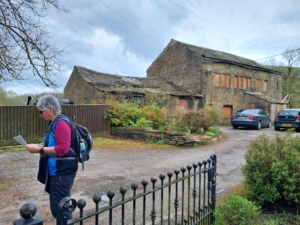 Constable Lee, where the walk started, on the edge of Rawtenstall was one of the eleven Forest of Rossendale vaccaries or cow farms run by the monks of Whalley Abbey from the 11th Century. Other than a couple of monks and lay-helpers, under Forest Law, no one else was allowed to live in the Forest until Henry VII deforested the area in 1509. The first chapel at ease was built at Newchurch in 1511 to service the few people living in the valley, and rebuilt in stone in 1561 (and again in 1824-6). There was only a population of about 1,000 people throughout the valley in the mid 1500’s. By 1760 the population has grown to about 12,000 people.
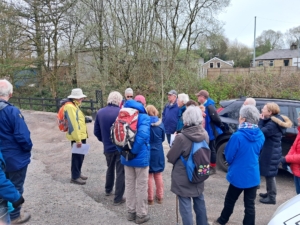 Families started to move down from small farmsteads on the moors to live in the newly built workers houses in the valley bottoms, wool was hand-worked at home, before moving into watermill production and steam power (the valley came late to steam compared to the rest of Lancashire), cotton was introduced – but again came relatively late to the valley, settlers from other areas of the country arrived and so from about 1780, and the start of industry and urbanisation the population grew to 90,000 by 1913.
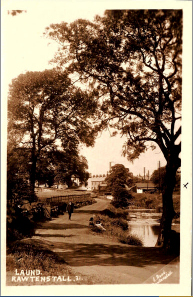 The area of Laund, by the side of Limy Water (in the valley bottom between Constable Lee and the original summer vaccary pastures of Oakenhead Wood) was owned by the Ashworth family living at Laund House during these early industrialisation days. Here, within about half a kilometre, we visited the site of an early mill at Collinge Fold Mill (later became Lee Brook Mill) – (Collinge Fold farm has a 1614 datestone), heard about the Irwell Reservoirs Scheme, looked over at what appears to be a very early remains of a chimney at the side of Limey Water, heard about Laund House and the family connections to both St James the Less church, and also to the Quaker Thomas Dockray and Hareholme Mill, noted where the mill reservoir had been at the side of the river, walked through Laund Mill, heard about Holmes Mill and Reedsholme Mill, noted there had been a Grange Works, before observing Constable Lee Mill. We also noted the Constablelee Bridge mill on the other side of the road, that produced Cotton Cellulose, before walking up the hill to see the large mill lodge for this mill – in the deep sided Lee Clough (also known as Tip Clough) – with plenty of available water incase of fire at the factory.
Walking along the top of Rawtenstall Cemetery we visited Waingate Village on our way down to Rawtenstall Market. There was so much more to see and learn about but time and the weather were against us now, so a quick walk back to where the cars weer parked. Half a dozen or so of us then went up to the New Waggoners for our lunch.

