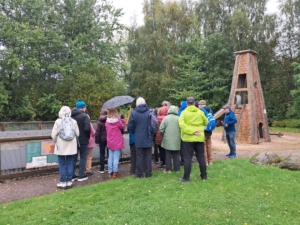
The weather may have been rather cool and showery but this did not dampen the spirits of the 22 members who enjoyed a coach trip to two remarkable sites in Northwich.
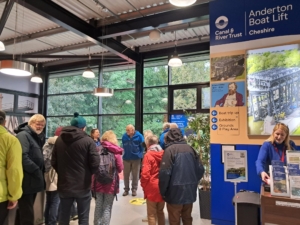 Our first port of call was the Lion Salt Works where we learnt about the extraction and processing of brine using the open pan method to make the different grades of salt. Our guide first described how the salt was formed in warm inland seas during the Triassic age 220 million years ago finally producing two very pure and thick rock salt beds in the Northwich area. The Romans were probably the first to extract salt in the area and their lead salt pans can be seen in the museum.
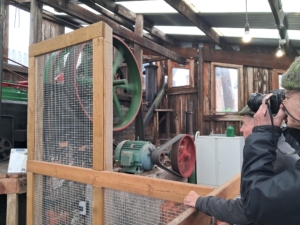 More recently, in the 1950s, 90% of the salt produced was exported to West Africa. However during the 20th century more efficient methods of extracting and refining salt were developed which led to the final closure of the salt works in 1986. The site was reopened as a museum in 2015 after a major redevelopment project.
fter a tasty lunch at the Salt Works we boarded the coach for the short journey to the Anderton Boat Lift Visitor Centre.
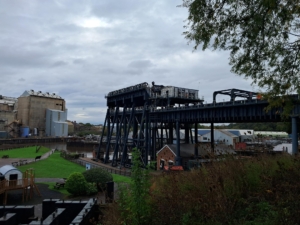 The boat lift, a giant three-storey-high iron edifice on the banks of the River Weaver, has been named as one of the ‘Seven Wonders of the Waterways’. Built to transport canal boats from the Trent and Mersey Canal to the River Weaver 50 feet below, the Anderton Boat Lift is one of only two working boat lifts in the UK.
Designed by Edwin Clark in 1875 it was in operation for over 100 years until it closed in 1983 due to corrosion, reopening to the public again in 2002 after a huge renovation project. There was too much water flowing in the River Weaver for a boat trip so instead we were lucky to be able to experience being lowered down to the river then raised back up again. All this in the comfort of the glass-sided trip boat ‘The Edwin Clark’ which, after being manoeuvred into a metal tank called a caisson, was gently lowered hydraulically to the river below. An amazing experience!