
We all met at Healey Bottoms (to the South of Healey Dell) where we were introduced by Frances and David to a volunteer for the Dell Nature Reserve, an ex-Turner’s Asbestos employee, who had kindly agreed to accompany us and would later supply us with lots of interesting information, join us for lunch and be really good company.
We had a look at the jumble of buildings still extant, an extensive site with several phases of occupancy, usage and building development, which included Healey Bottoms Mill which was a woollen mill from 1813 to around 1920. During the Word War II the entire complex became a Royal Ordnance Factory. Some of the buildings were still roofed and occupied, but part of the large 20th-century brick-built finishing complex was just a shell.
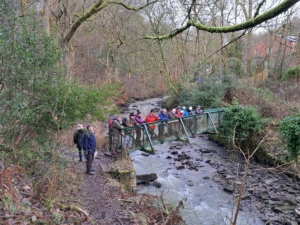 During the war this whole area was fenced off and the site still includes remains of many of the structures added during its use as a Royal Ordnance Factory. Crossing the River Spodden we wandered amongst the Magazines, several still intact but now overgrown and appearing incongruous in woodland. Of over thirty WWII Nissen huts, two were easily recognizable but the remainder were surviving with only concrete lower walls. In the middle of all this had once been Healey Hall Colliery but the shafts and building associated with it had been eradicated by ROF structures. However, we were able to see the round lodge for water storage for the mine, now surrounded by Nissen hut bases. We walked on past pump houses and an air raid shelter and crossed back over the river to admire the walling arising from the riverbed. Walking past a short row of cottages, built for the mill workers we came to where the entrance to the land taken over by the ROF once was. Looking at an old photograph we were able to discern the ‘hidden’ barrier and pillbox all overgrown with ivy, which was once the main entrance.
With kind permission we were able to explore the grounds of what once was Healey Bottoms Mill Lodge (now a fishery) set high above the mill. We could investigate where water entered the lodge and also saw the overflow systems both old and new. From a bridge where we stopped for our refreshments, it was interesting to see the leat, which wound round behind the old mill buildings to where there had once been a waterwheel. Also of interest, was a pill box for us to investigate.
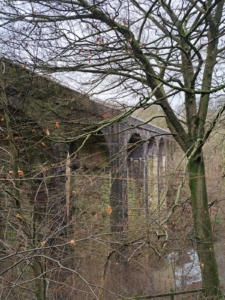
Leaving here and walking uphill we were able to look down on the River Spodden and be informed as to where the tunnel bringing water to the mill lodge began. Coming to the Railway Viaduct, such a splendid feat of engineering, we climbed up on to the disused railway line and walked along for quite some time, passing some interesting features and seeing two bridges, side by side, across a small ravine. The upper one had clearly carried the railway, but why the lower near identical one? The information board says the original structure may have slipped down the hillside and had to be replaced by the upper one. This is clearly nonsense, the lower one is complete and intact, as solid as the day it was built, and couldn’t have just slipped down without breaking up, and to a new suddenly fixed spot…? It was suggested that it was built on the original designed alignment that was later changed once the difficulty of building the railway along a steep hillside was realised.
At the end of the railway line we learnt that Shawclough Station and its very important railway sidings had been
demolished to provide modern housing, and how the sidings had been used for supplies to and from the ROF and also to and from Turners Asbestos Mill.
Crossing the Dell Road, we learnt that on a short stretch of what once was a toll road, leading down into Spotland, there were once three 19th century Textile Mills which were eventually taken over by Turners. The first one was Harridge Mill, flannel manufacturers, that closed in 1900 when Turners took it over and kept it mainly as a storage place for asbestos until it was demolished in the 1970s. From superb aerial photographs we were able to see that a covered chute, once came down the hillside from the rail sidings, which went directly into the second storey of the mill and we could pick out the abutment that once supported it. Nearby was another abutment for a second chute used for coal, that was taken from there to the mills on Rooley Moor Road. Adjacent was the site of a demolished row of cottages, that were built for the mill workers.
When we came to the vast site of Turners Asbestos, with several buildings still standing in a ruinous state, it was amazing to take in the size of it. Turner Bros (later Turner and Newall) became the largest Asbestos Mill in the world and we were able to see some detailed aerial photography, and therefore a great deal of interesting discussion followed.
We learnt that the mighty Turner Bros had very humble beginnings:
Samuel Turner had Clod Mill built here in 1855 manufacturing velvet, which enlarged and diversified when Turner Brothers Company was formed in 1871. They starting making asbestos packing and in 1879 it began spinning and weaving asbestos yarn and asbestos cloth and expanded rapidly into a giant factory and assumed a national, and later a global, prominence, with mines owned in Canada and South Africa. With 4000 workers it was Rochdale’s largest employer. It closed in 1998 and since then has been in several different ownerships and only partly demolished because work has been held up, as this is a very difficult and complex job requiring buildings to be tented before being pulled down. The bill for this is expected to be in excess of £20million.
Opposite Turner’s site was the site of Brotherod water powered textile mill, complete with its own large, picturesque lodge. This was opened in the 1780’s for wool carding and then converted to cotton spinning and closed in the 1930’s. Turners bought it and later had it demolished making way for a car park for their workers, although the pump house still stands. After this we walked on to discover the site of Meanley Textile Mill, in deep woodland, demolished some time before 1890 when two cottages were built with the remains. These have also since been demolished but we were able to ascertain the site of them and trace the leat to the lodge that used to supply water to the mill and then take it further along to the site of Harridge Mill, that we had visited earlier in the day.
We walked back from there to Healey Bottoms and the Dell Café, once administrative offices for the Mill Complex and ROF, where 12 places had been set for us round a table in the delightful upstairs café, where we enjoyed a well earned meal and a good chat.

