
Healey Dell, once a very industrial place with stone quarried in the surrounding hills, coal extensively mined, water powered textile mills built on the fast flowing river Spodden and the coming of the railway. A place of noise and smoke, but now with all these gone it has been made into a delightful Nature Reserve and when not busy is a place of peace, beauty and a haven for wildlife.
We met at Broadley Wood Car Park which was actually on the site of Broadley Wood Cotton Mill that opened in 1818 and closed in 1927, then demolished around 1960. It was unusual in that it was positioned on a stream rather than the much larger River Spodden where most of the other mill sites were located. We learnt that because of this, the stream was dammed to create a lodge and it was the first mill in the Dell to convert to steam. The lower part of the engine house was still extant and also ruins of the stable block. We walked up the steps besides the roaring overflow from the lodge and investigated the leat etc before starting uphill on the delightfully stone setted lane to Broadley Fold and Prickshaw Hamlet.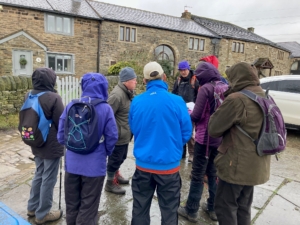
This was a prehistoric Pennine Hamlet and textile community of significant heritage value. Once, the agricultural and textile worker settlement supported a working population of 90, however by the 1950’s most of the occupants had moved into the towns and over a few years it became derelict. Happily the buildings were sensitively restored when it became an award winning conservation area in 1993. We were able to see the weavers cottages where wool was woven on the fourth floor and cotton in the lower floor, and what was once the Star Inn with its Brew House.
We left down the still setted Pricksaw Lane and observed the embankment that was built to carry a tramway that brought stone down from the quarries to the rubbing mill and railway in the 1880’s. From here we could see the large dam of Spring Mill reservoir, built in 1877 on a site that was originally a fulling mill. From the base of the dam we climbed up a track to a modern building site and were shown where once stood Spring Mill Print and Dye works. The interest here was that another later tramway was built from there, also leading down to the railway. As we walked down to the disused rail track we were able to discern parts of where the tramway once ran.
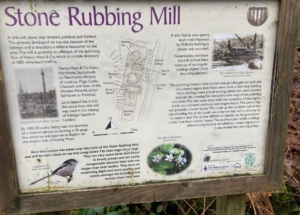 By the side of the rail track we saw where the sidings were for all this activity and were able to explore the interesting site of the short lived stone rubbing mill (1880 -1900) that the surrounding Quarry owners had built. After studying the plan, we saw where the engine house and huge circular polishing stones were housed. It is said that flags from here were used in the building of Trafalgar Square.
From there we left to see the completely wooded and overgrown site of Tonacliffe Wollen Mill, by the fast flowing river Spodden, first recorded in 1788 and closed just over a century later. To the North of it we investigated the now filled in mill lodge, and learnt that after the mill closure in the late 18th century, it was made into a filter bed for Whitworth Sewage works which now no longer exists, as sewage is piped to Rochdale under the now closed railway line (now a right of way for walkers and cyclists). 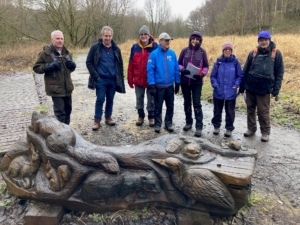 As we walked down the banks of the river we could see the broken weir and the leat running from Tonacliffe mill on the opposite bank, and pick up where it crossed via a pipe and became a leat on our side of the river, where we sat in the drizzle for elevenses, on the picnic benches.
Following the leat across under the footbridge we came to the picturesque site of a large pond that was once the lodge for Broadley Mill. At the southern end of it we could see the leat that once fed the two waterwheels which we understand were in the vicinity of a great pile of demolition debris. High above us in the trees we were told about a Medieval Bloomery (for smelting iron), no longer extant but was discovered in someone’s garden in 1919, with remains of charcoal and slag.
Broadley Mill, originally a C16 water powered Corn Mill which converted to wool in 1804 and then the 1844 mapping shows it as both wool and cotton and quite a large concern. We were able to study the plans and saw that the main building straddled the Spodden north of the bridge. We walked down the east side of the river to see where mill buildings once were, along with footings of cottages and the Mill Owner’s house. Returning to the bridge we went down through the wooded area on the West Bank, again seeing building remains, until we came to a circular depression which was once housed the mill’s Gasometer – quite a rare find.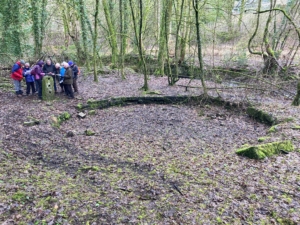
It was then back to the bridge to walk up to what was Broadley Station, the only station on the line between Rochdale and Bacup that has a surviving platform. We were able to see from photographs where the signal box was, to the rear of the platform, and what was once a boarded over gap in the platform, under which the signal wires and point rodding would have run. We saw where the sidings once were and where wooden steps once led down from Station Road. We learnt that the railway opened in 1870, after many years in the making, as it was often beset with problems on the steep sloping soft ground, and had to cross over deep set Healey Dell Gorge. Sadly the railway closed to passengers in 1947, and then to freight in 1967 but at least us, as walkers in lovely Healey Dell, can enjoy the remains of its route.
From the station we walked along the line noting where the trains, that once held ammunition for the Royal Ordnance Factory, had a siding. Immediately beyond that we were able to walk over the magnificent 103’ high viaduct to the far side where we came down steps onto the road, which we crossed and joined a footpath. From there we could truly admire this splendid construction with its 8 arches, the middle ones of which are parallel to the river and hence at an angle to the railway above, making for interesting geometry.
Just below here in the shadow of the viaduct a path took us down besides what once was a towering three storey warehouse for Th’Owd Mill I’th Thrutch. It is thought that originally there was a 15th century corn mill on this narrow site between road and river, which was converted to a fulling mill in the mid 17th century. We learnt that it also had four arched stone sulphur stoves and a pond for water storage along a precipitous path that we were able to see, but thought best not to explore with a group! We inspected the fulling stocks and the large still extant wheel pit which housed an enormous 33’ diameter waterwheel. Because there was so little level ground in the gorge a 2-storey perching house (where fabric was inspected over a perch, imperfections marked out, the cloth weighed, measured and ticketed) had to be built on three stone arches straddling the river. There was just one surviving arch extant, as the last one was swept away in the Boxing Day floods of 2015. After looking at photos of the ruinous three storey building in this confined space, with the river roaring beneath it, we wondered at the ingenuity of the architects and builders. Cloth from Healey Bottoms Mill was brought here to be treated in the fulling stocks and then moved onto the sulphur stoves for bleaching, until it closed around 1880.
We moved a little upstream to see the collapsed weir and to discuss the ways and means of getting water to the mill along launders to the waterwheel. As we walked along the path and up the steps we were able to see photographs and note where the Victorians came here at the weekends, to appreciate its beauty and sit in shelters and on stone benches whilst admiring the roaring river, and what would be in the summer, beautiful leafy glades. We were able to look down on another weir and again discuss how it may have been used to direct water to Th’owd Mill.
Nearing the end of our walk was Fairies Chapel where you could take some steep narrow steps down to the river to see a place steeped in folklore, but as it was nearing time for lunch we passed by, perhaps to explore it another time.
After getting back to the car park most of us headed off to The Red Lion in Old Whitworth for lunch and a good chat.
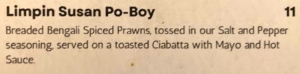
Traditional Whitworth fare!
Round the table we learnt about the history of Whitworth and its famous son, John Taylor who in the mid 18th century transferred his veterinary skills to humans and treated many people with deformities successfully, including Charles Dickens and the then Archbishop of Canterbury, who stayed at the Red Lion whilst undergoing treatment. After lunch some of us stayed to see the surrounding buildings with their blue plaques, the Taylor family vault, the stocks and walked up the walled path, known as Cripples Way, to the unusual church, where from the outside we admired its architecture and many interesting gargoyles. By this time the wind had got up and it was raining so we were glad to get back to the cars after a very interesting day out.

