
Constant Mary
Who’s that?
Constant Mary was the name given to a waterwheel 10ft (3m) wide and 12′ 6″ (3.8m) diameter.
Constant – because the waterwheel was constantly turning and only stopped at the end of the day.
Mary – after the wife of the proprietor of the Dunkirk Colliery, Mr Richard Wroe-Walton of Altham.
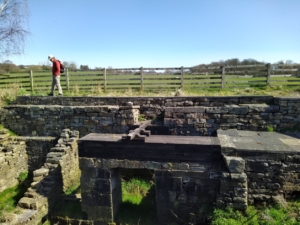 Through large cogs the waterwheel turned a winding drum also 12ft 6ins (3.8m) diameter. This drum had an endless rope attached and was used to haul coal waggons on an inclined tramroad from the mine workings which were about 200ft (60m) under the River Calder and up to a mile (1.5km) away.
The complex was known as Dunkirk Colliery. (Note: the tracks were known as tramroads or plateways, made up of cast iron L shaped rails, each about 3ft (1m) long, not to be confused with steam or electric tramways in towns and cities.)
The constantly moving haulage rope was wrapped about three times around the drum and pulled the rope at about walking pace. The descending side of the rope travelled down the decline with empty waggons lashed to the rope via a chain and hook attached to each waggon. The waggons were attached singly to the rope about 20ft (6m) apart and ran on one side of a double track about one mile (1.5km) long under the river to a depth of over 200ft (60m).
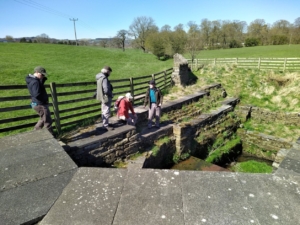 The waggons were unhitched from the rope at the bottom of the mine and filled with about 6cwt (300kg) of coal. The full waggons were then lashed to the ascending side of the haulage rope, again by the chain and hook, to be pulled up the incline on the opposite track.
(This system is possibly the first of its kind in Britain so extremely special).
When at the surface the full waggons were unhitched from the still moving rope and formed into a train of about 5 or 6 waggons. The train was pulled by a Lancashire horse along the tram road to the coal staithes near Cock Bridge.
Prior to the Constant Mary waterwheel haulage system being built, coal was brought from Altham via a plateway sat on stone block sleepers and over a wooden bridge over the River Calder and then to the coal staithes.
(Interesting fact. Cock Bridge is on Whalley Road near the Game Cock Inn and the lane now leading from the bridge past Read Garden Centre is called Coal Staithe Lane)
More about Dunkirk Colliery
Dunkirk Colliery was established in the 1780’s to connect with the earlier mines under Altham. As with most pits in the Calder Valley, it worked the Arley Seam which was about 1m thick. The colliery consisted of the new haulage pit at Constant Mary, and down by the riverside, an atmospheric Newcomen type pumping engine to de-water the mine and a water balance engine to take men and materials in and out of the mine, and coal for the steam.
The mine was ventilated by at least two waterblast airshafts, the water coming from leats which brought water from the surrounding hills.
(Before fans were introduced into mines to provide ventilation waterblast airshafts were used. A burst of water from the leat was directed to drop down the shaft, setting up a convection current below ground to provide fresh air for the miners).
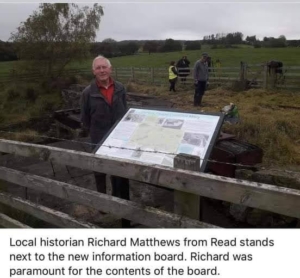
The ingenuity of these 18th century mining engineers is mind-boggling. The information board which Richard Matthews helped to devise shows a map of the area with lots more detail about this amazing site. We’re lucky to have Richard on our SPAG committee as an Industrial Archaeologist who is happy to share his knowledge and enthusiasm with us.

