
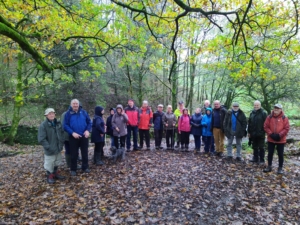
On a cold, wet November morning, 21 SPAG members assembled outside the Rostron Arms at Edenfield in anticipation of a short but fascinating walk along Plunge Road to the ruins of Plunge Mill.
This picturesque area is a regular haunt of dog walkers, summer picknickers and young people. Whilst also we enjoyed the beauty of the autumn colours, it was the history that we’d come for and we weren’t disappointed.
 First, we stopped to look at the terraced houses called Stone Pits. These were built by the Booth family in the small stone quarry to house local millworkers. Next door is The Mount, built by the same family as their own residence. Thomas Booth built Edenfield’s first mill (Booth’s Fulling Mill) between 1765 and 1767. One of our group recalled visiting the house in the 1990’s and explained that there was a huge ballroom which may have been the result of the extension built by Edwin Barlow in 1909.
Next to the house is a large, green field called Mary Wife Field (more on this name later) on which the 1851 OS map clearly shows tenterframes scattered across it. Finished pieces of cloth were hung on tenterhooks to stretch and dry after the fulling process.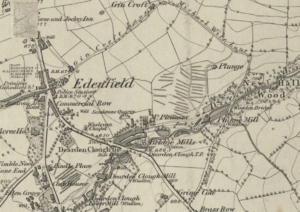
Eventually, we passed the old ford (and modern pedestrian bridge) which was the crossing point of Michael Wife Lane. This unusual name is believed to be after Mary Nuttall, wife of Michael Nuttall, who was fined in 1618 for not maintaining the road and finally, put in the stocks in 1624 for still not doing so.
In front of us was a silted up weir, whilst behind us lay the mill lodge (reservoir) and beyond that, the ruins of Plunge mill. Restored by Rossendale Groundwork in the 1980s we spent a considerable amount of time, looking, discussing and theorising on the various changes which were made during its 75 years working history.
On our return journey we looked over the wall at Bridge Mill, now a multi-use site. Richard Rostron built this fulling mill after taking a 999 year lease on the land in 1824. Richard was known as ‘Pinch Dickey’ for his cheese-paring ways and the slope on the road in front of the mill was known as ‘Dicky Broo’. Perhaps this was well deserved as in 1808 he put out work to handloom weavers in Rochdale because he could pay a third less wages! He is also said to have watered his cloth make it up to the required weight and thickness.
Regardless, the mill prospered and was also used for cotton spinning and weaving by Richard’s sons Lawrence and John who were pioneers in the use of power looms. In 1826 all their 58 looms were attacked by rioters but if you’d like know more about this, we have a walk on 10th December ‘Reading the Riot Act’. Please visit our website www.digspag.org.uk for more details.

