
 In an area so heavily associated with cotton manufacture, it can be hard to remember that wool was Rossendale’s staple textile product for many centuries. It was therefore interesting to start our tour of Helmshore Mills Textile Museum by viewing the water powered fulling section.
Unfortunately, the mill lodge or reservoir had been drained for maintenance but this also served to demonstrate the efficiency of the sluice gate which enabled the water to pass easily into the adjacent River Ogden. What was hidden in the sea of mud may never be known but an earlier operation revealed a trolley now on display in the museum (more on this later) but it makes a change from shopping trolleys! The water wheel and huge wooden fulling stocks were therefore silent but were of particular interest to those who joined our recent trip to the ruins of the Plunge Fulling Mill. 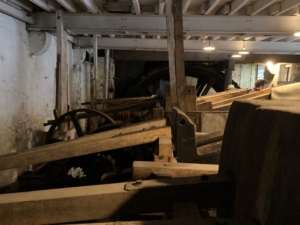
Prior to the advent of the Spinning Jenny and later power looms, the spinning and weaving of wool was a cottage industry undertaken by the whole family. From raw wool to woven cloth, the ‘piece’ would be sent to the mill for fulling which involved soaking in urine to remove the lanolin and other oils (the trolley found in the lodge was for transporting it) and then beating it until felted. After drying on tenter frames, this produced a heavy, water-resistant cloth which could then be used for a variety of purposes, including warm clothing. Think for example of the great coats worn by soldiers in the First World War.
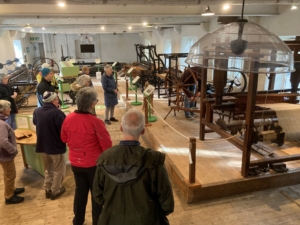 The Turner family purchased the land for the first mill in 1789 but it was William Turner JP; the son of one of the founders who oversaw the expansion of the business, including the erection of a larger carding and spinning mill. This meant that the whole process was controlled by William; in addition to his other business interests.
After welcome refreshments in the café, we moved on to cotton manufacturing. Starting with a handloom, our guide explained how the wife and children would spin the yarn whilst the man of the house undertook the weaving. A 16 spindle spinning jenny from about 1750 was the first improvement, spinning was a far slower process than weaving, this was followed by Arkwright’s water frame.
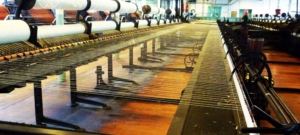 On the next floor we saw the recycled cotton which had been turned into slivers, finally processed into rovings, ready for spinning. This is the only complete and original floor of 714 spindle spinning mules to survive, incredibly, the operation was then demonstrated. A lot of discussion took place about the working conditions, the dangers involved and the ages of the operatives.
After a tiring but fascinating three hours we left to consider what life must have been like for those who toiled in the mills. When the museum reopens in the Spring, a tour is highly recommended.

