
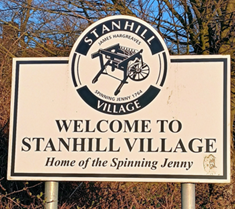
 It takes some imagination to believe that the pleasant, quiet village of Stanhill – on the outskirts of Oswaldtwistle – was the birthplace of the industrial textile revolution!
Twenty SPAG members joined a two-hour “Walk and Talk” on a beautifully sunny day, covering subjects, buildings and stories between the 7th and 20th centuries.
The walk started with an explanation of the economics and politics of calico printing in the early 18th century, as well as the role of the local and entrepreneurial Robert “Parsley” Peel (the grandfather of the future Prime Minister of the same name) in enabling James Hargreaves’ invention – the “Spinning Jenny” – to be used and further developed in Peel’s nearby Brook Side Mill. Our group saw a plaque on a nearby small cottage where James Hargreaves lived with his large family, and where he invented his machine which was to start the increase in productivity in the textile industry.
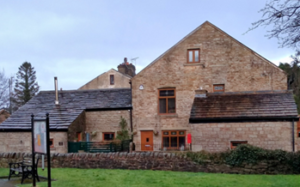
James Hargreaves’ small cottage (red post box attached)
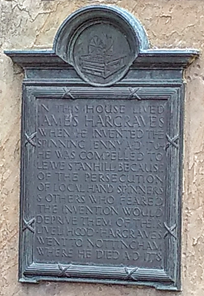
Plaque on James Hargreaves small cottage – the site of the Spinning Jenny’s invention
(Stanhill village has an interesting website, including a demonstration of spinning, here.
A walk over the M65 bridge soon brought the group to the site of Stanhill Prisoner of War (POW) camp, nearly all evidence of which was demolished in the extension of the motorway. During World War Two, it was a camp for Italian POWs, then after the war a POW hostel holding German prisoners prior to their eventual repatriation. A powerful BBC 2 “Timewatch” programme called “The Germans We Kept” about those held at Oswaldtwistle and other POW camps is available via YouTube here.
Also, a book “Enemies Become Friends” was published by the local Methodist minister’s daughter, Pamela Howe Taylor, and tells of how the local churches reached out to the defeated prisoners – and their impoverished families back in Germany – after the war.
A stroll round to the rear of the playing field was rewarded with views of Peel Fold Farm – the home of Robert “Parsley” Peel – where he was said to have etched the shape of a parsley leaf on to a pewter plate, giving rise to his first experimental template for his “parsley” printing pattern.
And just up a slope from there, the group were able to view the last remaining foundations of what are thought to be the Officers’ Quarters of the Stanhill POW camp, and another adjacent building whose function is officially unknown, though the presence of multiple sitings of 4-inch pipe plumbing and evidence of porcelain pedestals in the floor led the group to its own conclusions!
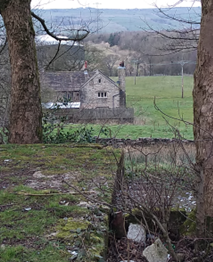
Peel Fold Farm, with the foundations of the Stanhill POW camp Officers’ Quarters in the foreground
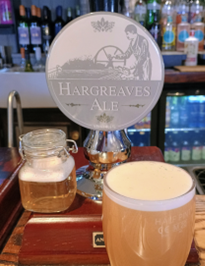
On return to Stanhill village, most of the group availed themselves of refreshment at the “Stanhill Pub and Kitchen” where James Hargreaves’ legacy is remembered, not only by memorabilia on the pub’s walls, but also by a “James Hargreaves” Ale!

