Visit to Grane Mill
Twenty one members were greeted at Grane Mill, Haslingden by Anthony Pilling, Chairman of the Grane Mill Preservation Group, who gave us a very comprehensive tour of this Grade ll* listed former weaving mill.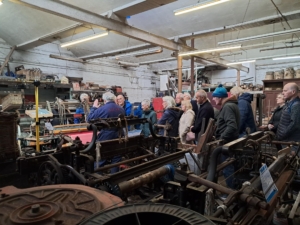
One of the first questions asked was “Why is it called Grane Mill when it’s in Haslingden?” Here’s why: Grane Mill began in the Grane Valley as a small water powered spinning mill. A second mill for weaving was built later and by the 1800s both mills were running with steam power as Grane Manufacturing Co. Ltd. In the late 1890s the area was acquired for reservoirs by Bury and District Joint Water Board and with compensation paid for both mills the company decided to build a completely new, up to date mill at Haslingden concentrating on weaving.
This new mill, completed in 1907 in the Edwardian era, was built as a single storey ‘horizontal process flow’ manufacturing plant. Anthony described how the mill was designed so that the spun cotton coming into the building and the finished cloth going out all had to pass by the watchful eye of the manager!
On our tour we were shown different types of looms manufactured by several companies, Anthony is a descendant of John Pilling who estalished a firm of loom makers in 1819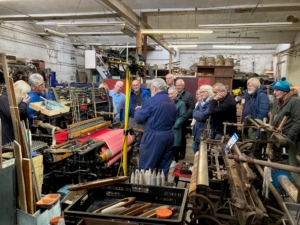
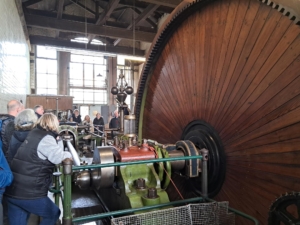
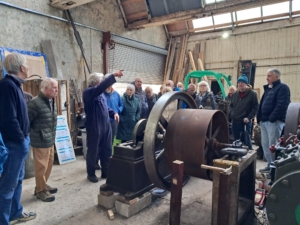 . Anthony and a dedicated team of volunteers have spent countless hours at the mill restoring the original steam-driven engine made by S.S. Stott an engineering firm just across the road from the mill. We were delighted to watch the engine in motion and the flywheel turn albeit powered by an electric motor as the Lancashire boilers are out of action. In another part of the mill the Preservation Group has a collection of smaller engines now powered by compressed air.
This unique survival of a purpose built complex with its original mechanical fittings is rightfully protected as a scheduled monument and is a wonderful reminder of the days when Lancashire was a world leader in textile engineering and manufacturing.