
A group of SPAG members met outside Owd Bett’s pub recently to explore the industrial archaeology of the Upper Cheesden Valley. Our leader, Mike Knowles, gave us the history of this well known building which was originally a farmhouse built in 1796 by Richard and Mary Ashworth (a well known name in the local area). Originally known as the Hare and Hounds, Mike explained that in the 1850s the pub was run by Elizabeth Ramsbottom and the pub became known as Owd Bett’s.
Our walk began along Ashworth Moor Road, which became a turnpike road in 1795. Traces of the old toll bar can still be seen by Cheesden Bridge which nowadays marks the boundary between Rossendale and Rochdale.
Mike recounted that Cheesden Brook which flows through the valley was, during the 19th century, a watercourse which provided power for a staggering 15 mills and employment for 2000 people. Operatives in the mill would typically work up to 70 hours per week. Most of the mills remained water powered until their closure as water was cheaper than coal driven steam engines.
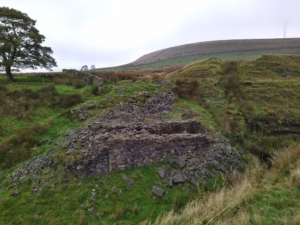 High upstream we visited the site of Four Acre Mill built around 1810 as a woollen mill by John Haworth who devised an ingenious method of providing an adequate flow of water with two lodges, a weir and a goyt. The wheel house which once housed a huge waterwheel 36 feet in diameter and 4 feet across, is still visible but most of the mill has now been demolished.
Further downstream Cheesden Pasture Mill was powered by water from numerous springs which kept the lodge adequately supplied. This mill had a water wheel and operated from a drop of 30 feet. In the 1840s the mill ran 4000 spindles and employed 40 workers some of whom lived in a row of terraced houses, the remains of which can be seen nearby. Interestingly the owners introduced a steam engine and made their own gas to light the mill.
Continuing our walk downstream we passed the site of Lower Pasture Mill (1830), Cheesden Bar Mill which was built in 1840 and closed in 1898 and Upper Lumb Mill, known more familiarly as Mr John’s.
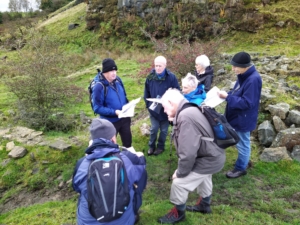 A short walk to the South of the main road brought us to the impressive remains of Cheesden Lumb Mill. Built in 1785 as a woollen mill by 1850 the woollen machinery had been replaced with ‘Devils’ – machines used for reclaiming cotton fibres from spindle cops.
 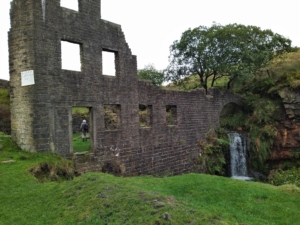 The water wheel was originally 30 feet in diameter and 6 feet wide. The mill was run for many years by Alice Ashworth, a shrewd and confident business woman who was forced to close the mill in 1898 to enable the construction of Ashworth Reservoir.

