
A Visit to the Weavers Cottage, Rawtenstall
Well actually, it’s not a weavers cottage at all but more about that later. Ten members arrived for a tour led by Civic Trust Trustee, Kathy Fishwick. Kathy started by asking us if we wanted to learn about the building or the history of weaving. The response was that we wanted some of both!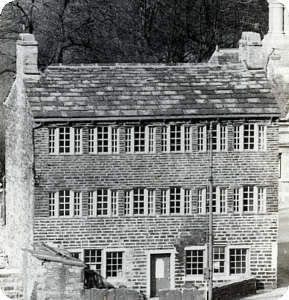
It is generally believed that Lancashire wove cotton and that Yorkshire wove wool but the reality is slightly different. Lancashire produced large quatities of wool but most of it was shipped to Europe as complete fleeces but in the reign of Henry VII (1457-1509), spinning and weaving was established in England, in both counties. It wasn’t until the 18th century that cotton became Lancashire’s staple product.
The ‘Weavers Cottage’ was probably built in around 1780 as a loom shop. Several handlooms were installed and it continued weaving new trial designs, which would then be mass produced on water powered looms in the newly erected mills. It wasn’t until later that it was used as accomodation for mill workers, rather than handloom weavers.
As we watched a demonstration of handloom weaving we noticed that the excellent lighting in the room was via South facing windows whereas the weaving sheds that are still prevalent across the area, have North facing windows. The explantion is that weaving wool requires dry conditions (as in this building) whilst cotton requires a cool, damp atmosphere. Handloom weavers cottages used for cotton weaving, were often built with well-lit cellars for this purpose.
One of our members, whose father was a tackler in a Lancashire mill, explained that inside a shuttle, it is the pirn, around which the yarn is wound that releases the yarn as the shuttle flies across the loom. This is fine for cotton or wool but one millowner in Macclesfield, who wove silk, found that the silk continued unwinding as the shuttle stopped. To overcome this, a small piece of rabbit fur was glued inside the shuttle but rabbit pelts were too expensive and so he imported grey squirrels! The rest as they say, is history.

